TL;DR
- UK-based tech recruiting agency helping hire remote developers from CEE & CIS for UK companies
- Channel: LinkedIn-led outbound, with email as a secondary touch
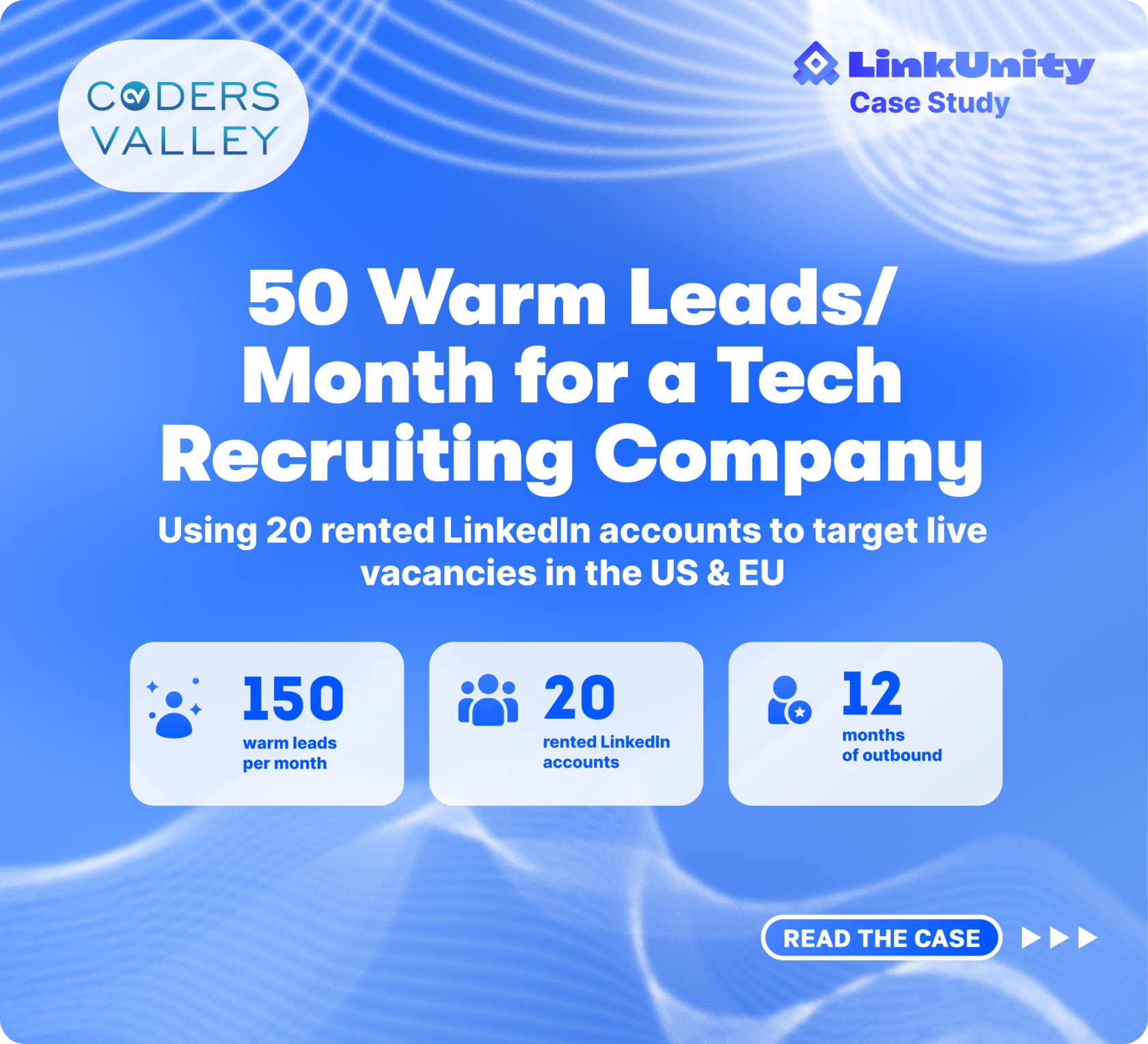
- 20 rented LinkedIn accounts from LinkUnity, each sending ~20 invites per day
- The campaign ran consistently for 12 months
- ~150 marketing-qualified leads per month on average, from hiring managers with active vacancies
About Coders Valley
Coders Valley is a UK-based recruiting agency that helps US and European tech companies hire remote developers and IT specialists from Eastern Europe.
They were operating in one of the noisiest markets possible: hiring managers in the US and EU get messages from recruiting agencies every single day, and most of them pitch more or less the same thing – “we also hire developers in Eastern Europe.” The market was saturated and undifferentiated.
Coders Valley needed a predictable, scalable way to generate leads and a way to stand out with a clearly competitive offer in their outreach, instead of relying only on referrals or a single founder’s LinkedIn profile. The goal of their outbound system was simple: not just say “we recruit in Eastern Europe,” but show why their offer was better than dozens of other agencies contacting the same companies.
The Challenge: Predictable Lead Gen for a Service Business
Coders Valley sells a service, not a product – and services are invisible by default.
They were facing:
- A saturated recruiting market in the UK
- Prospects already working with multiple agencies
- Generic “we’re a great recruiting partner” outreach is getting ignored
They needed to:
- Focus only on companies that were actively hiring.
- Reach the right people (CTOs, hiring managers) at the right moment.
- Scale outreach safely over months, not weeks, without burning a single LinkedIn profile.
The Stack: 20 Rented LinkedIn Accounts + Smart Targeting
Instead of blasting cold lists by email only, Coders Valley built its engine around LinkedIn outbound – and used email as a follow-up channel.
For infrastructure, they partnered with LinkUnity:
- Rented 20 LinkedIn accounts from LinkUnity
- All accounts were ID-verified, NFC-passport-backed, with the official LinkedIn verification badge
- Each account had a warm, realistic network and a relevant persona (recruiter, talent partner, etc.)
Every weekday:
- Each account sent around 20 targeted connection invites
- That’s ~400 invites per day across the whole stack
- All with tight ICP filters and live vacancy triggers
Step 1 – Start From Live Vacancies, Not Static Lists
Coders Valley didn’t start with a generic list of companies.
They started with live, open roles.
The team monitored:
- LinkedIn job posts
- UK job boards (Indeed, Totaljobs, etc.)
- Company career pages
They looked for:
- Open tech roles (e.g., Backend Engineer, Full-Stack Developer, DevOps, etc.)
- Signs of active scaling (multiple tech vacancies at once)
- Companies hiring remotely or open to distributed teams
At the same time, they filtered out:
- Vacancies clearly posted by other recruiting agencies
- Office-only roles with no flexibility
- Companies that didn’t match their target profile, using Clay to enrich and filter accounts by size, geography, and tech focus
Only a fraction of all open roles made it onto their outreach list – but every prospect they contacted had a real, current hiring need.
Step 2 – Outreach From Rented LinkedIn Accounts
Once a suitable vacancy was identified, Coders Valley used the 20 LinkUnity accounts to go directly to the people behind the role.
For each target company, they:
- Identified the relevant decision-makers:
- Founders
- COO
- CTO / Head of Engineering
- Hiring Managers / Heads of Talent
- Sent a personalised LinkedIn connection invite from one of the rented accounts:
- Referencing the exact live vacancy
- Positioning Coders Valley as a partner that can help fill that role faster and cheaper with remote talent
- After the connection was accepted:
- Followed up with a short DM and, if needed, a more detailed email
- With a concrete, numbers-based offer (cost savings, speed, guarantee)
Important: all initial contacts started on LinkedIn from the rented accounts.
LinkedIn, via the 20 rented accounts, acted as the supporting channel: anyone who didn’t reply to the email was followed up on via LinkedIn, turning the campaign into true multi-channel outreach.
Step 3 – A Concrete, Numbers-Driven Offer
The messaging was not “we’re another recruiting agency.”
For each role, the offer sounded like:
- “You’re hiring a Senior Backend Engineer in London at £X.”
- “We can bring you candidates from Eastern Europe in a similar time zone, at 30–50% lower salary, without compromising on quality.”
- “That directly saves you £Y per month on this hire and helps extend your runway or stretch your budget across 2–3 roles instead of one.”
By tying outreach to a real open vacancy and backing it with clear numbers, Coders Valley made the value instantly tangible.
This is why their messages, sent at scale from LinkUnity accounts, didn’t feel like generic agency spam.
Step 4 – Daily Volume and Timeline
Because they had 20 accounts in rotation, Coders Valley could stay consistent without overloading any single profile.
Rough operating pattern:
- 20 LinkedIn accounts
- ~20 invites per account per day
- ≈ 400 targeted invites per weekday
- Stable sending rhythm over 12 months
Not every invite turned into a conversation, and not every conversation turned into a client – but:
- LinkedIn became a reliable deal-flow channel, not an ad-hoc activity.
- The team had a daily, trackable system instead of random “reach out when we have time” efforts.
Results
By combining live vacancy targeting with 20 rented LinkedIn accounts from LinkUnity, Coders Valley achieved:
- Around 150 marketing-qualified leads per month on average
- Pipeline coming directly from hiring managers with active roles, not cold HR lists
- A sustainable outbound engine that ran for a full year without major disruptions
Additional benefits:
- Better brand visibility in the UK tech and startup space
- Multiple “faces” of Coders Valley engaging with the market (20 personas instead of 1–2)
- Lower risk: if one account hit a limit or issue, 19 others kept the system running
Why This Worked
This model worked because it combined:
- High-intent targeting
- Every outreach touch was tied to a real, open role.
- Prospects were already in hiring mode.
- Solid infrastructure
- 20 ID-verified LinkedIn accounts from LinkUnity = safe volume and resilience.
- Activity was spread out, natural, and human-like.
- Clear, numerical value proposition
- Concrete savings, runway extension, and real alternatives.
- Not vague “we’ll help you hire better.”
- Consistent execution over time
- Daily volume, every week, over 12 months.
- No big spikes followed by long pauses.
How Other Agencies Can Use the Same Playbook
If you’re running a recruiting or B2B services agency, you can replicate this:
- Monitor open vacancies in your niche.
- Filter down to companies and roles where your offer is genuinely stronger.
- Use multiple rented, verified LinkedIn accounts from LinkUnity to:
- Send targeted invites from relevant personas
- Reference the exact role in your outreach
- Follow up with clear numbers and guarantees
- Layer email on top as needed – but let LinkedIn be the first touch.
- Keep volume steady and track leads/month, not just messages sent.
Coders Valley proved that with the right infrastructure provided by LinkUnity and the right system, LinkedIn can be turned into a predictable pipeline channel – even in one of the most competitive spaces: tech recruiting.